
September 4, 2026
You volunteer for your community's board and suddenly you’re expected to understand budgets, reserves, insurance, contracts, governing documents, collections, enforcement, state law, meetings, vendors, communications, and conflict.
You’re also doing it for free and often expected to be during work or in the evenings or on the weekends. Then there’s the part that makes HOA governance especially unusual: you still have to live next door to the people affected by the decisions you make.
If you think about it, that’s a pretty unappealing job description.
Recent research suggests the burden is real. In a 2026 Foundation for Community Association Research survey, 44% of respondents cited time demands as a factor affecting whether board members continue serving. Another 29% cited personal attacks or incivility, and 25% cited conflict with homeowners.
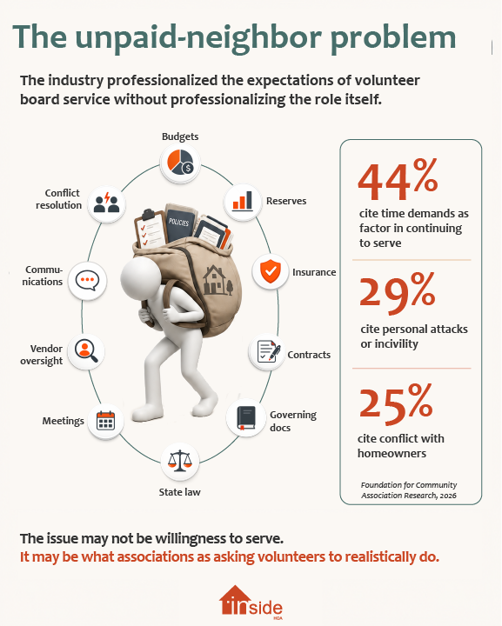
So maybe the issue isn’t that people don’t want to contribute. Maybe the issue is what happens AFTER they raise their hand.
Over time, the expectations placed on volunteer boards have become increasingly professionalized, while the role itself has remained unpaid and volunteer-led. In addition, the complexity keeps growing: legal requirements, insurance challenges, financial decisions, and homeowner expectations. Community Associations Institute (CAI) itself now describes volunteer board members as responsible for increasingly complex financial, legal, and operational matters.
But volunteers don’t magically get more time. And this is where we think technology has a role to play.
Not in replacing judgment, or in deciding what's fair, or in making a difficult vote easier. But in reducing the amount of time volunteers spend hunting for information, answering the same questions, routing requests, piecing together context, and managing administrative work that technology should be able to handle better.
Maybe the goal isn’t to replace the work of governing. Maybe it’s to give volunteer boards more room to actually govern.