September 10, 2026
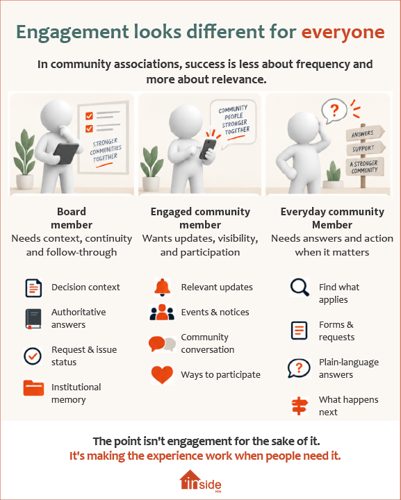
One thing we learned by mapping the different ways board members and community members actually interact with their community is that ‘engagement’ doesn’t look the same for everyone.
➡️ A board member may need to be closely involved in decisions, documents, requests, finances, and community issues.
➡️ An engaged community member may regularly follow updates, participate in conversations, or simply want to stay informed about what’s happening.
➡️ An everyday community member may barely think about their community association until they need a form, have a question about a rule, want to understand a decision, or something happens near their property.
All three can be appropriately engaged, just in different ways.
Traditional software metrics can get a little misleading in a community association. The software world tends to equate frequent use with successful adoption—daily active users, weekly active users, time spent in the platform. But community members aren’t employees using a work tool every day. More usage doesn’t automatically mean the experience is working better.
In an HOA or POA, the better measure may be whether people can get what they need when they need it—without having to become a power user first.
✴️ Can they find the information they need?
✴️ Understand what applies to them?
✴️ Complete a request without figuring out an unfamiliar process? Get an answer without emailing three people?
✴️ Know what happens next?
That changes the engagement tactics. Instead of repeatedly asking everyone to “use the platform,” communities need different reasons for different people to come back: useful updates for those who want to stay informed, simple workflows for those trying to get something done, clear context for people trying to understand a decision, and easy access to answers for someone who may only engage a few times a year.
It also means boards and staff can’t outsource engagement to the software. Their participation still matters. What they communicate, where they communicate it, how consistently they use the platform, and whether community members learn to trust it as the place to go all shape adoption over time.
So the goal is NOT to turn every member into a power user.
More importantly, it’s to create a community experience that works for people when and how they actually need it.
For InsideHOA, that means designing around how people actually engage with their community—not how often we wish they would engage with the platform.